
The Truth Behind Poland’s ‘Anti-Vampire’ Graves

IN MODERN VAMPIRE LORE, THE process for becoming undead typically involves a darkly romantic setting, a fang-y bite, and a long, dramatic drink from the neck. But that’s the result of the last hundred years or so of vampire stories. In post-medieval Poland, undead evil was far more banal and less elegant; it was believed to possess the souls of those who had the misfortune to die early in epidemics, by suicide, or simply before being baptized. So when it came time to bury these poor souls, care was taken to ensure they would not provide an easy vessel for a malicious, supernatural force.
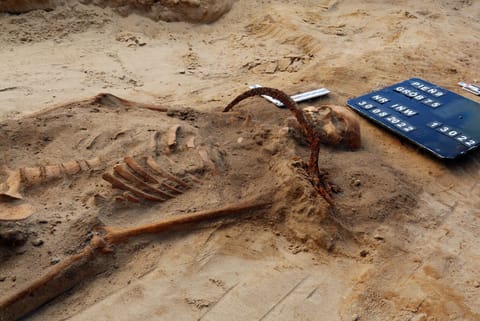
In late July 2023, archaeologists working on a 17th-century cemetery outside the southeastern Polish village of Pień excavated the remains of a child who appeared to have been interred in the period’s “anti-vampire” style. The child (its sex is unknown) placed face-down—with a padlock near its feet.
“That was very typical for an anti-vampire security practice,” says Dariusz Poliński, from the Middle Ages department at Nicolaus Copernicus University in Toruń, who led the excavation.
It’s impossible to know a post-medieval undertaker’s exact intentions, but Poliński’s conclusions about the practice were bolstered by a similar grave nearby. in 2022, his team excavated the body of a young woman who’d also been buried with a padlock, this time on her toe, and a sickle positioned over her throat.
The locks, sickle, and prone position fall into the category of burial known as apotropaic—that is, people buried in a way meant to ward off evil. Said evil could come from forces outside the grave or, more often, within. Should a vampire or other undead presence awaken, the reasoning goes, the lock and downward-facing position would hold it in place. Woe to the revenant who tried to rise with a sharp sickle positioned over its throat.
Apotropaic graves of this sort date back to the Early Middle Ages and have also appeared in Slovakia, Hungary, Austria, and Romania. In addition to the features observed at Pień, such burials may involve decapitations, stakes through the chest, or protective coins placed in the deceased’s mouth. They tend to appear most frequently during times of mass tragedy—epidemics, wars, or any other time when people might see the tragedy around them and assume that evil is afoot.
Seventeenth-century Poland was an ideal setting for this. That is, it was an especially brutal time to be alive. “This was a century of wars, crisis, and very cold weather,” Poliński says. “It was a small ice age.”
Read the Latest Agriculture News in Marathi & Watch Agriculture videos on Agrowon. Get the Latest Farming Updates on Market Intelligence, Market updates, Bazar Bhav, Animal Care, Weather Updates and Farmer Success Stories in Marathi.
