
The Maillard Reaction

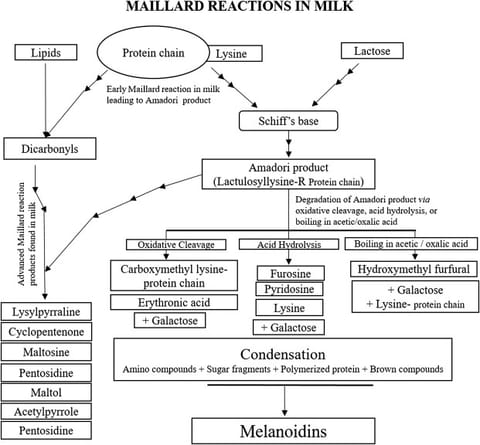
The Maillard reaction is the non-enzymatic reaction of an amino group with a reducing group (often a reducing sugar) leading to the formation of compounds which ultimately polymerise to form brown pigments.
Browning, or the Maillard reaction, creates flavor and changes the color of food. Maillard reactions generally only begin to occur above 285°F (140°C). Until the Maillard reaction occurs meat will have less flavor. Shown above are two identical dishes cooked (left) below (140°C) and right at much higher temperatures. Both caramelization and the maillard reaction only occur on the right producing the noticeable brown color.
The Maillard reaction is a chemical reaction between an amino acid and a reducing sugar, usually requiring the addition of heat. Like caramelization, it is a form of non-enzymatic browning. The reactive carbonyl group of the sugar interacts with the nucleophilic amino group of the amino acid, and interesting but poorly characterized odor and flavor molecules result. This process accelerates in an alkaline environment because the amino groups do not neutralize. This reaction is the basis of the flavoring industry, since the type of amino acid determines the resulting flavor.
In the process, hundreds of different flavor compounds are created. These compounds in turn break down to form yet more new flavor compounds, and so on. Each type of food has a very distinctive set of flavor compounds that are formed during the Maillard reaction. It is these same compounds that flavor scientists have used over the years to create artificial flavors.
The Maillard reaction should not be confused with Caramelization which occurs with sugars.
Although used since ancient times, the reaction is named after the chemist Louis-Camille Maillard who investigated it in the 1910s.
Products with Maillard reactions
The Maillard reaction is responsible for many colors and flavors in foodstuffs:
caramel made from milk and sugar
the browning of bread into toast
the color of beer, chocolate, coffee, and maple syrup
self-tanning products
the flavor of roast meat
the color of dried or condensed milk
6-acetyl-1,2,3,4-tetrahydropyridine (1) is responsible for the biscuit or cracker-like odor present in baked goods like bread, popcorn, tortilla products. The structurally related compound 2-acetyl-1-pyrroline has a similar smell, and also occurs naturally without heating and gives varieties of cooked rice their aroma. Both compounds have odor thresholds below 0.06 ng/l [1].
Read the Latest Agriculture News in Marathi & Watch Agriculture videos on Agrowon. Get the Latest Farming Updates on Market Intelligence, Market updates, Bazar Bhav, Animal Care, Weather Updates and Farmer Success Stories in Marathi.
